
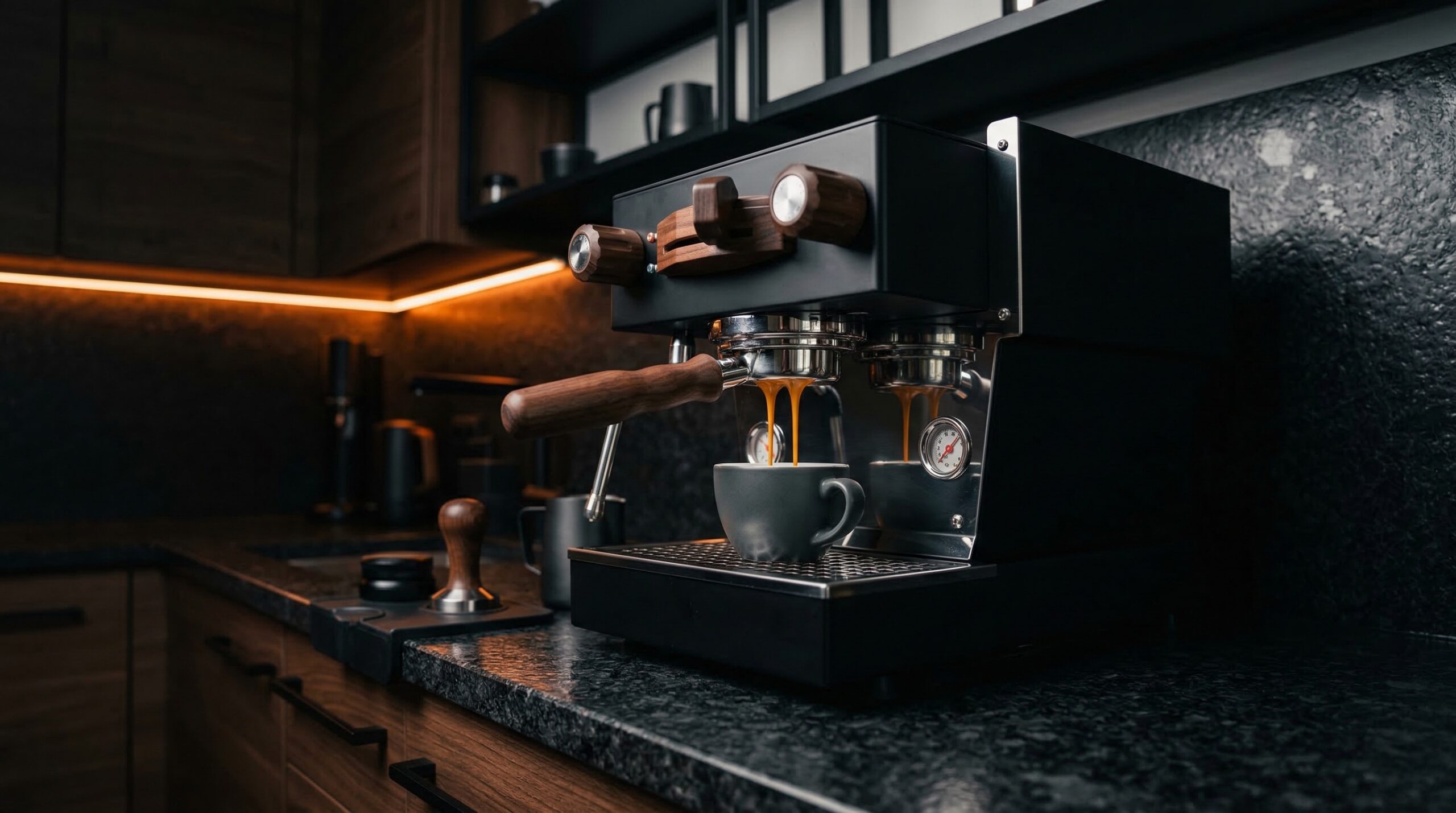
TL;DR
Espresso at home is less of a morning chore and more of a rewarding hobby. After testing a wide range of machines, from budget-friendly thermoblocks to heavy-duty Italian boilers, the standout for most people remains the Breville Bambino Plus due to its automated milk frothing and fast heat-up time. However, for those seeking a “buy it for life” machine, the Rancilio Silvia offers unmatched durability. If you are on a strict budget, the Casabrews 5418 Pro provides a functional entry point for the price of a few months’ worth of lattes. Remember that your choice of machine is only half the battle; the quality of your espresso will always be limited by the consistency of your coffee grinder.
The Reality of Making Espresso at Home
Before you dive into the world of portafilters and pressure gauges, we need to have a heart-to-heart about what you are actually signing up for. Unlike a standard drip coffee maker or a pod machine, making espresso is an active craft. It is a ritual that involves precision, patience, and a fair amount of trial and error. When you step away from the convenience of Nespresso capsules, you are choosing a path that offers significantly better flavor, but it requires you to understand the variables of dose, yield, and timing.
I have spent years testing these machines, and I can tell you that the “first shot” of the day is rarely the best one. You will spend time “dialing in” your beans, adjusting your settings as the coffee ages, and cleaning your equipment. If you enjoy the process of creating something with your hands, this journey is incredibly fulfilling. If you just want caffeine at the push of a button with zero cleanup, you might find the learning curve frustrating. Your investment isn’t just financial; it’s an investment in a new skill set that will eventually allow you to outperform your local cafe from the comfort of your kitchen.
Choosing the Right Type of Machine
Semi-Automatic vs. Automatic: Control vs. Convenience
Your first major decision involves how much work you want to do. Semi-automatic machines are the industry standard for home enthusiasts. You engage the pump, and you decide when to stop the shot. This gives you total control over the strength and volume of your espresso. If you have some barista skills—or the desire to learn them—this is the category where you will find the most satisfaction. Semi-automatic setups like those from Breville or Rancilio require a separate, high-quality component to handle the beans. For a deeper look at the equipment involved, our coffee grinders guide explains why the “other” machine on your counter is actually the more important one.
Automatic machines, often called “super-automatics,” handle everything from milling the beans to tamping and brewing. While convenient, they often lack the texture and nuance of a manually pulled shot. They are great for high-volume households where speed is the priority, but they are significantly harder to repair and maintain over time. For most readers of Coffee Picks Pro, the semi-automatic route offers the best balance of quality and longevity.
Thermoblock vs. Boiler Systems
The heating system inside your machine dictates how many drinks you can make in a row. Thermoblocks act like a tankless water heater, heating water on demand as it passes through a coiled pipe. They are ready to brew in seconds, making them perfect for someone who only drinks one or two cups a day. However, they can struggle with temperature stability during back-to-back shots.
Boiler systems, found in “prosumer” machines, keep a reservoir of water at a constant temperature. These are the “tanks” of the coffee world. They take longer to warm up (often 15-20 minutes) but provide the thermal mass needed for consistent shots and powerful steam. If you frequently entertain guests or make three or more milk-based drinks every morning, a boiler-based machine is a much wiser investment. You can find more specialized recommendations in our espresso machines section to match your specific daily volume.
| Product Name | Best For | Price Range | Pros/Cons | Visit |
|---|---|---|---|---|
| Breville Bambino Plus | Beginners & Small Kitchens | Check price on Amazon | + Auto Milk, 3s Startup – Plastic Parts, Small Tray |
|
| Casabrews 5418 Pro | Ultra-Budget Entry | Check price on Amazon | + Low Price, Compact – Fragile Build, Slow Steam |
|
| Gaggia Classic Pro | Enthusiasts & Modders | Check price on Amazon | + Huge Community, Repairable – Temp Surfing Needed |
|
| Rancilio Silvia | Durability (BIFL) | Check price on Amazon | + Tank-like Build, Steam Power – No PID, Steep Learning Curve |
|
| Profitec Go | Premium Performance | Check price on Amazon | + Built-in PID, Pressure Gauge – Higher Price, Large Size |
|
| Cafelat Robot | Manual Enthusiasts | Check price on Amazon | + Zero Electronics, Easy Clean – No Milk Steamer, Physical Effort |
|
| Wacaco Picopresso | Travel & Portability | Check price on Amazon | + Pro Results, Pocket Size – Manual Pumping, Small Yield |
Best Entry-Level Espresso Machines (Under $500)
Breville Bambino Plus
In practice, pulling shots with this machine consistently hits the sweet spot—most home baristas notice the difference in crema quality from day one. Your morning routine benefits from a three-second startup time, which is almost unheard of in the espresso world. It is the optimal all-rounder for anyone who wants high-quality lattes without spending weeks practicing their milk steaming technique. The automated steam wand does a surprisingly good job of creating microfoam, allowing you to focus on the espresso itself.
The Good
- Incredibly fast heat-up time thanks to the ThermoJet system.
- Hands-free milk frothing with adjustable temperature and texture settings.
- Compact footprint fits easily under standard kitchen cabinets.
- Includes both pressurized and unpressurized baskets to grow with your skill level.
The Bad
- The lightweight build means the machine often slides on the counter when you lock in the portafilter.
- The drip tray is tiny and fills up quickly due to the frequent auto-purging of the steam wand.
- Mostly plastic internal components may not last as long as traditional boiler machines.
Should You Buy? Best for busy professionals who want café-quality lattes at home with minimal fuss. Skip if you prefer a heavy, industrial-feeling machine that can be easily repaired at home.
Casabrews 5418 Pro
If you are curious about the hobby but hesitant to drop $500, this is the most logical starting point. It offers a surprisingly capable 20-bar pump and a sleek stainless steel finish that looks more expensive than its price tag suggests. It is a no-frills machine that focuses on the basics, providing a way to practice the mechanics of tamping and pulling shots without a massive financial risk.
The Good
- Exceptional value for the price, often found under $200.
- Simple, intuitive interface that isn’t intimidating for beginners.
- Compact design is perfect for dorm rooms or small apartments.
The Bad
- The steam wand lacks the power found in more expensive units, making it difficult to get perfect latte art texture.
- Temperature stability can be inconsistent between shots.
- Durability is the primary concern; many users report longevity issues after a year of heavy use.
Should You Buy? Best for the budget-conscious beginner who wants to test the waters of home espresso. Skip if you plan on making back-to-back drinks for a household.
The ‘Buy It For Life’ Mid-Range ($500 – $1,000)
Gaggia Classic Pro
This machine is a legend for a reason. It uses a full-sized 58mm portafilter, the same standard used in commercial shops, which means your accessories will be compatible with high-end upgrades later. The real magic of the Gaggia is the community. There are countless forums and YouTube tutorials dedicated to modding this machine, from installing PID controllers for temperature accuracy to changing the pressure springs. It is a machine that grows with you.
The Good
- Commercial-grade build quality with an iconic industrial aesthetic.
- Extremely easy to find replacement parts and perform DIY repairs.
- Massive community support makes troubleshooting any issue simple.
The Bad
- Out of the box, the brew pressure is often set too high for ideal espresso, requiring a spring swap mod.
- The small boiler requires “temperature surfing” (a specific timing ritual) to ensure the water is the right temperature for brewing.
- The clearance between the portafilter and drip tray is quite tight, making it hard to fit a scale and a tall mug.
Should You Buy? Best for the aspiring “home barista” who loves to tinker and wants a machine that can last a decade. Skip if you want perfect results on day one without any modifications.
Rancilio Silvia
Commonly referred to as “Miss Silvia,” this machine is built like a tank. It features a heavy brass boiler and a professional steam wand that can texture milk better than almost anything in its price bracket. It doesn’t have flashy lights or touchscreens; it just has solid switches and a reputation for extreme durability. If you want a setup that feels like it belongs in a professional kitchen, this is it.
The Good
- One of the most powerful steam wands in the sub-$1,000 category.
- Exceptional thermal stability once the boiler is fully heated.
- Timeless, rugged design that avoids the “appliance” look of cheaper machines.
The Bad
- A notoriously steep learning curve; beginners often struggle with consistency initially.
- Long warm-up time (20+ minutes) compared to modern thermoblock machines.
- Like the Gaggia, it lacks a PID, meaning you have to manage temperature manually.
Should You Buy? Best for the serious enthusiast who prioritizes milk texture and build quality above all else. Skip if you need your coffee ready in under five minutes.
Profitec Go
The Profitec Go is the answer to the common complaints about the Gaggia and Rancilio. It comes from the factory with a built-in PID (digital temperature control) and an external pressure adjustment. This removes the guesswork from the brewing process. It offers the stability of a high-end prosumer machine in a single-boiler format that fits on most counters. It’s a refined, modern take on the classic home espresso experience.
The Good
- The PID display doubles as a shot timer, which is incredibly helpful for consistency.
- Fast heat-up time for a boiler machine (around 5-7 minutes).
- High-end internal components typically reserved for machines twice the price.
The Bad
- The price pushes the limit of “entry-level” for many users.
- As a single boiler, you still have to wait for the machine to heat up further to switch from brewing to steaming.
- The vibrations can be a bit noisy compared to more expensive rotary pump machines.
Should You Buy? Best for those who want the best possible shot quality without needing to perform aftermarket mods. Skip if you are on a strict budget.
Specialist and Manual Espresso Machines
Cafelat Robot
The Robot is a minimalist’s dream. There are no pumps, no circuit boards, and no heating elements to fail. You provide the hot water and the physical force to pull the shot. Because it is a direct lever machine, you have ultimate control over the pressure profile. This allows you to produce “sweet, chocolatey” shots that rival machines costing thousands of dollars. It is also the easiest machine to clean, as there is no backflushing or descaling required.
The Good
- Produces world-class espresso with zero electrical components.
- Virtually no maintenance required beyond a simple rinse.
- Small and portable enough to take on camping trips or to the office.
The Bad
- It cannot steam milk, so you will need a separate frother for lattes.
- Requires a high level of physical strength and technique to maintain 9 bars of pressure.
- Pre-heating the heavy steel basket is necessary for lighter roasts.
Should You Buy? Best for the “espresso purist” who drinks straight shots and hates cleaning equipment. Skip if you love lattes and cappuccinos.
Wacaco Picopresso
Don’t let the size fool you. The Picopresso is a professional-grade manual espresso maker that fits in the palm of your hand. It uses a naked portafilter, allowing you to see the extraction as it happens. For travelers or those with zero counter space, it is the only way to get true, high-pressure espresso without a massive machine. It’s an impressive feat of engineering that demands a high-quality grinder to function correctly.
The Good
- Truly portable; it fits inside a travel bag with ease.
- Standard 52mm basket allows for proper dosing and extraction.
- Surprisingly durable construction for such a small device.
The Bad
- The workflow is tedious; prepping a second shot takes significant time.
- Small water reservoir limits you to single shots or very short doubles.
- Cleanup can be messy if you aren’t careful with the residual pressure.
Should You Buy? Best for travelers and hikers who refuse to compromise on coffee quality. Skip if this is intended to be your primary daily machine at home.
What Real Users Are Saying (Reddit Insights)
General Sentiment
The community consensus on r/espresso and similar forums is that espresso is a “hobby of diminishing returns.” Most users agree that while a $3,000 machine is beautiful, a $500 machine paired with a $500 grinder will produce 90% of the quality. There is a strong culture of encouragement for beginners, but it’s often tempered with a warning: espresso is expensive. Many Redditors emphasize that the “experience of making” the coffee is just as important as the taste, which is why manual and semi-automatic machines are favored over pod systems or automatics.
Top Complaints & Warnings
The most frequent warning for beginners is the “Hidden Cost Trap.” Many new owners buy a Breville Bambino and realize they can’t get a good shot because they are using a standard blade grinder or a cheap burr mill.
“The cheapest decent setup is probably around $500 which is a Breville Bambino and a Kingrinder K6 hand grinder. Espresso as a hobby isn’t cheap.” — r/espresso
Another common complaint involves the durability of consumer-grade machines. Users often report that entry-level Breville and DeLonghi units have a “low skill ceiling” and can be difficult to repair once they break out of warranty, unlike the Gaggia or Rancilio which are built with standard industrial parts.
Budget Tips & Value Picks
For those looking to save money, the community almost universally recommends starting with a high-quality manual hand grinder.
“For the price, hand grinders give you better coffee… my K6 makes a drastically better coffee for lighter roasts over the inbuilt Breville grinders.” — r/JamesHoffmann
By spending $100 on a manual grinder like the Kingrinder K6 instead of $300 on an electric one, you can put that extra budget toward a better machine or fresh, locally roasted beans. Another tip is to look for the “Gaggia Classic” used on local marketplaces, as they are easily refurbished even if they look rough.
Essential Accessories: Completing Your Setup
Your machine is just the engine; you still need the wheels and the fuel. To get consistent results, you absolutely must have a digital scale that measures to 0.1 grams. This allows you to ensure you are using the same amount of coffee every time. A “precision” tamper that fits your basket perfectly will also help prevent “channeling,” where water finds a weak spot in the puck and ruins the flavor. Finally, never underestimate the importance of your beans. No machine can make old, oily grocery store beans taste like a specialty cafe latte. Look for beans roasted within the last two to four weeks for the best results. For more details on the small things that make a big difference, check our coffee accessories guide.
Best Espresso Machine by Segment
Best for Milk-Based Drinks (Lattes/Cappuccinos)
The Breville Bambino Plus is the winner here. Its ability to automatically texture milk to a specific temperature and foam level makes it the most approachable option for someone who primarily drinks lattes. You can find more automated options in our best espresso machine roundup.
Best for Small Counter Space
The Wacaco Picopresso or the Breville Bambino Plus are your best bets. The Picopresso can be tucked away in a drawer entirely, while the Bambino Plus has a footprint smaller than a standard sheet of paper.
Best BIFL (Buy It For Life) Option
The Rancilio Silvia takes this title. Its heavy-duty construction and lack of complex electronics mean that with basic maintenance and the occasional gasket change, it can easily serve you for 15 to 20 years. It represents the gold standard for home durability.
Frequently Asked Questions
Do I really need a separate grinder for a home espresso machine?
Yes, absolutely. Espresso requires a very fine, consistent particle size that standard coffee makers do not need. Most entry-level machines, like the Gaggia Classic Pro, cannot function properly with pre-milled coffee or a cheap blade grinder. Investing in a dedicated espresso grinder like the Baratza Encore ESP is arguably more important than the machine itself for achieving that rich, syrupy texture.
Is the Breville Bambino Plus worth the extra money over the base model?
For most people, yes. The “Plus” model includes an automated steam wand and a 3-way solenoid valve. The solenoid valve is a critical feature that sucks away excess water after a shot, leaving you with a dry coffee puck that is easy to knock out. Without it, you are left with a “soupy” mess. The auto-milk frothing is also a major convenience for morning lattes.
What is the best espresso machine for a beginner who wants to make lattes?
The Breville Bambino Plus is the most beginner-friendly choice due to its fast heat-up and automated milk features. If you want something more traditional and “pro,” the Profitec Go is an excellent step up that offers more control through its digital temperature display. Both are better choices than cheaper, plastic machines that struggle to produce enough steam for a creamy latte.
How much should I budget for a complete home espresso setup?
A realistic starting budget is between $500 and $700. This covers a machine like the Bambino Plus or Gaggia Classic Pro, a capable grinder (either a manual one or an electric unit like the DF54), a basic scale, and a tamper. While you can spend less with a Casabrews 5418 Pro, you may find yourself wanting to upgrade very quickly as your skills improve.
Can I use a hand grinder for espresso shots?
Yes, and it is often recommended for those on a budget. High-quality hand grinders like the Kingrinder K6 provide a better grind quality than electric grinders that cost twice as much. However, be prepared for a bit of a workout; it takes about 30-45 seconds of vigorous cranking to prepare a single double-shot dose, which can become an “annoyance” during busy mornings.
What is the difference between pressurized and unpressurized portafilters?
A pressurized basket has a tiny hole that creates “fake” pressure, allowing you to get decent results from pre-ground coffee or a cheap grinder. An unpressurized (standard) basket relies entirely on the resistance of the coffee puck itself. While unpressurized baskets are harder to use, they are the only way to achieve true, high-quality espresso with complex flavor profiles.
Other Notable Alternatives Worth Considering
If the main picks don’t quite fit your style, consider the La Marzocco Linea Micra. It is a high-end luxury option that brings commercial performance to your kitchen, though it carries a price tag in the thousands. For those who love the classic aesthetic, the La Pavoni Lever machines are beautiful, chrome-plated pieces of art that offer a purely manual, tactile brewing experience. Finally, the Turin Legato is gaining popularity as a budget-friendly machine that includes features like a PID and a pressure gauge, often outperforming its price point in terms of raw specs.
Which Machine Should You Buy?
The “perfect” machine depends entirely on what you value most: convenience, durability, or price. If you want the easiest path to a great latte in under two minutes, the Breville Bambino Plus is the clear winner. For the enthusiast who wants to learn the craft and keep their machine for decades, the Gaggia Classic Pro or the Rancilio Silvia offer a more traditional and rewarding path. If you are a purist who only drinks straight espresso, the Cafelat Robot provides the best flavor for the least amount of maintenance. No matter which you choose, remember that the most important ingredient is your own curiosity and willingness to experiment. Happy brewing!
This page includes affiliate links. We earn a small commission if you buy through them.
Affiliate disclosure: This page includes affiliate links. We earn a small commission if you buy through them.